News

Launch at UNESCO: The Second Phase of EOSC Open Science Observatory

New chapter for Open Science Monitoring: Launch of the second phase of the EOSC Open Science Observatory

Earlier this month, the international conference Open Science: Monitoring Progress, Assessing Impact brought together researchers, policymakers, and institutional leaders at UNESCO Headquarters in Paris and online. Over two days, participants from around the world discussed how to track the progress and impact of Open Science in ways that are meaningful, inclusive, and actionable.

Organized by UNESCOOpenAIREPathOS, EOSC Track, and the Open Science Monitoring Initiative (OSMI), the conference offered a unique platform for exchanging knowledge, refining tools, and aligning efforts across the globe on Open Science. For the EOSC Track project, it marked the official launch of the EOSC Open Science Observatory - a key milestone in our journey.

Written by Tereza Szybisty

What is the EOSC Open Science Observatory?

The EOSC Open Science Observatory is a policy intelligence platform designed to monitor how Open Science is progressing across Europe. It provides a structured, data-informed view of national policies, practices, and trends, combining quantitative and qualitative evidence to support strategic decisions by policymakers, institutions, and researchers. Its purpose is not to rank or compare, but to inform, reflect, and guide progress - making the invisible visible.
Why monitoring matters: connecting to the ERA and Open Science

During the session, Stefan Liebler (Policy Officer, European Commission, DG RTD) put the EOSC Open Science Observatory into policy context. He reminded us that Open Science is not just a principle—it's a structural policy within the ERA Policy Agenda 2025–2027. "Enabling Open Science via sharing and re-use of data, including through the EOSC" is one of the eleven long-term ERA priorities. Monitoring plays a central role in this effort, helping assess progress, identify gaps, and ensure alignment with EU-level goals.

Monitoring is also considered a federating capability of the EOSC Federation, enabling shared understanding and joint action. Stefan presented the Monitoring Framework for National Contributions to EOSC and Open Science, implemented through the EOSC Steering Board’s annual survey a key data source for the EOSC Open Science Observatory.

Launch of the second phase of the EOSC Open Science Observatory

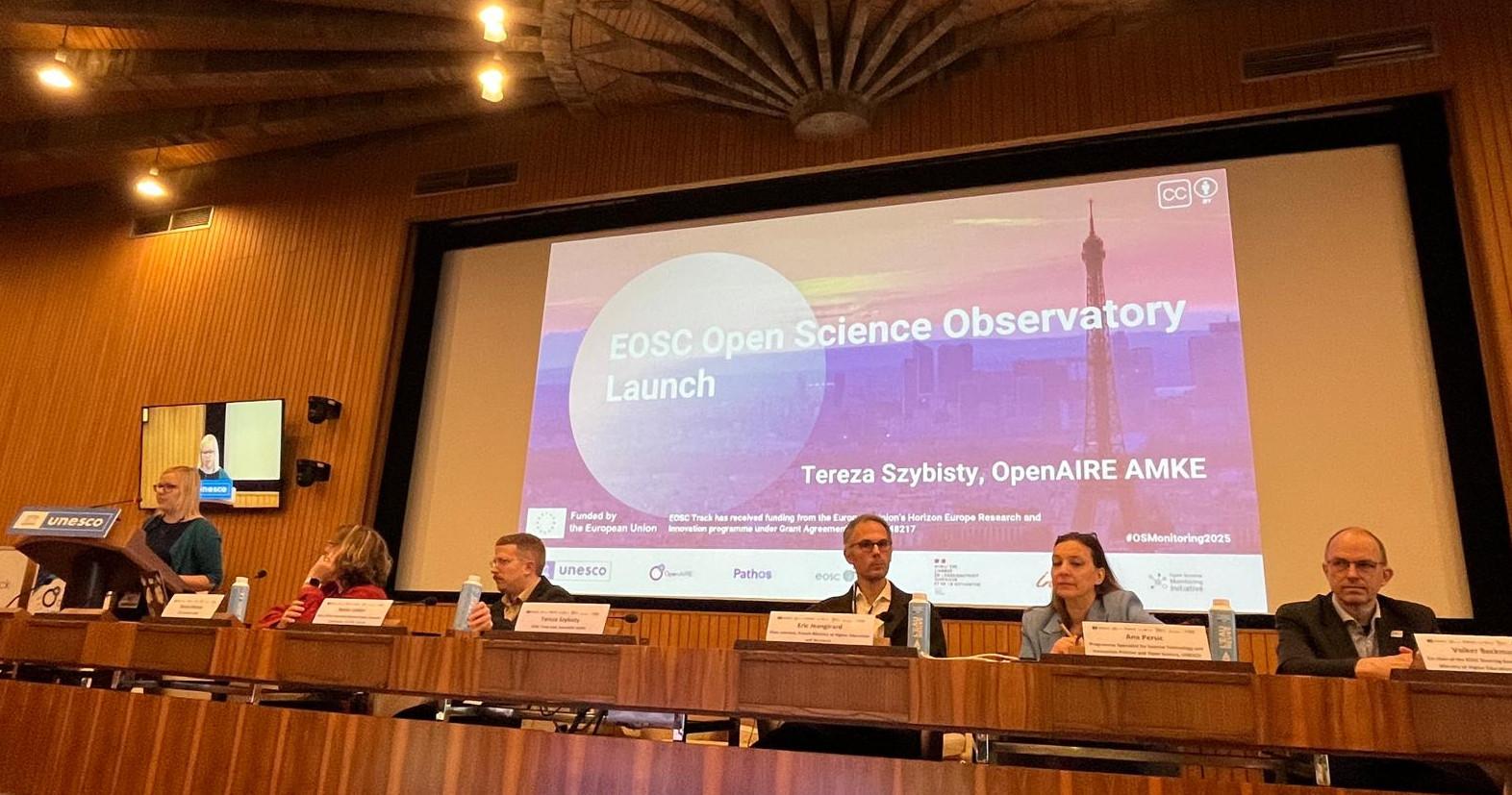
The official launch of the next phase of the EOSC Open Science Observatory was presented by Tereza Szybisty (OpenAIRE AMKE), who highlighted that the platform was built with and for the community. Co-created with national experts and aligned with initiatives like the OSMI Principles of Open Science Monitoring, the EOSC Open Science Observatory was designed to be transparent and open by design: from code and methodology to data and visualisations, everything is openly available under open licences.

Tereza walked participants through the data workflow and methodology that powers the platform. This includes a multi-level validation process for the national survey responses, enrichment and aggregation pipelines from the OpenAIRE Graph, and the integration of qualitative insights from country narratives and emerging sources like the European Open Science Resources Registry. She concluded with lessons learned: monitoring is a learning process, and frameworks must remain adaptable and reflective, evolving alongside Open Science.

From National to Global - How can national, European, and global monitoring systems interoperate while staying locally relevant?

The session concluded with a panel discussion moderated by Natalia Manola (OpenAIRE AMKE), bringing together national, EU, and global perspectives on Open Science monitoring. Panelists included:

  • Eric Jeangirard, Data Scientist at the French Ministry of Higher Education and Research, offered insights into national monitoring frameworks and the French experience with aligning national dashboards with broader European initiatives.

  • Volker Beckmann, Co-chair of the EOSC Steering Board, highlighted the EOSC Steering Board’s efforts to build a coordinated monitoring system that respects national diversity while contributing to a shared European evidence base.

  • Ana Persic, Programme Specialist at UNESCO, connected the conversation to the global level, sharing how UNESCO’s work on monitoring the implementation of the Open Science Recommendation is creating a common, global reference point that still allows for regional and national adaptations.

  • Stefan Liebler, European Commission (DG RTD), reinforced the need for a federated approach, where monitoring is built from the ground up, but structured enough to allow comparability and strategic alignment.

The panel underscored the importance of shared definitions, the need for balanced and inclusive monitoring frameworks, and the value of embedding monitoring into broader policy and institutional strategies. It also served as a reminder that behind every dataset are real practices, policies, and people working to make Open Science a reality.

What comes next?

The launch of the EOSC Open Science Observatory is just the beginning. New features, expanded data sources, and deeper community engagement are on the horizon. Monitoring is not a static task—it’s a dynamic, collaborative process that supports the evolution of Open Science. 

Stay tuned for more!

Read more …Launch at UNESCO: The Second Phase of EOSC Open Science Observatory

  • Hits: 542

EOSC Track at the Open Science Conference 2025: Showcasing the AI-Enhanced European Open Science Resources Registry

EOSC Track at the Open Science Conference 2025: Showcasing the AI-Enhanced European Open Science Resources Registry

As AI reshapes the way we produce and share knowledge, Open Science becomes more than a principle - it becomes the compass guiding responsible innovation. At the Open Science Conference in Hamburg, we joined this ongoing conversation by presenting the European Open Science Resources Registry, showing how AI can help Europe navigate its evolving policy landscape with greater clarity and transparency

Written by Tereza Szybisty

The Open Science Conference 2025, held on 8–9 October in Hamburg, brought together researchers, data stewards, librarians, infrastructure providers, policymakers, and practitioners for two days of discussion on the future of Open Science. Hosted by the Leibniz Strategy Forum Open Science and organised by the ZBW – Leibniz Information Centre for Economics, this year’s edition placed a special spotlight on the rapidly evolving intersection of Open Science and artificial intelligence. With keynotes on FAIR Digital Objects and AI-ready data infrastructures, as well as a rich programme of discussion sessions, solution workshops, and poster demos, the conference provided a vibrant forum to explore both the opportunities and challenges that AI introduces for transparency, reproducibility, and responsible research practices. The EOSC Track team was proud to present the European Open Science Resources Registry during the poster and demo session.

Enhancing discovery, policy, and practice: a hands-on demo of the European Open Science Resources Registry

Our poster drew in participants curious about how Europe can better navigate the growing landscape of Open Science policies, strategies, and best-practice documents. Many visitors were especially interested in the European Open Science Resources Registry’s role as an integrated component of the EOSC Open Science Observatory, designed to provide easy, trustworthy access to national-level Open Science resources. The real conversations began as we walked participants through the workflow behind it.

We explained how the European Open Science Resources Registry is AI-enhanced, combining human curation with Natural Language Processing and Machine Learning. This hybrid approach allows the system to ingest documents from diverse national sources, extract and structure their content, identify themes, classify topics, and generate concise summaries. AI supports the heavy lifting (automating text segmentation, metadata extraction, translation, tagging, and enrichment), while human reviewers ensure quality, accuracy, and alignment with the Observatory’s established methodology. The balance of automation and expert oversight sparked thoughtful discussion about responsible and transparent use of AI in research governance.

A highlight of the session was the on-the-spot demo. Alongside the poster, we invited attendees to explore the EOSC Open Science Observatory dashboard. This hands-on demonstration allowed participants to navigate the latest visualisation features, see how national contributions feed into the platform, and understand how the European Open Science Resources Registry will soon integrate directly into the Observatory. 

Throughout the conference, one theme consistently emerged: the community is eager for tools that bring coherence and visibility to the complex Open Science landscape. By transforming scattered policy documents into structured, comparable, and easily discoverable resources, the European Open Science Resources Registry will empower policymakers, research managers, and practitioners to navigate Open Science developments with far greater clarity and confidence.

Check out the poster

The European Open Science Resources Registry is now entering its final phase before release on the EOSC Open Science Observatory

This marks an important milestone: for the first time, Europe will have a central, AI-supported resource that brings together Open Science policies and strategic documents in a structured, comparable, and discoverable way. The conversations in Hamburg demonstrated just how timely and necessary this effort is.

As we prepare the Registry for public launch, we will keep enhancing its data, refining its workflows, and ensuring that its insights meet the needs of policymakers, researchers, and the broader Open Science community. We look forward to sharing the full platform soon and to continuing this collaborative journey toward more transparent and evidence-based Open Science governance.

Watch this space - the European Open Science Resources Registry is nearing its launch on the EOSC Open Science Observatory!

Read more …EOSC Track at the Open Science Conference 2025: Showcasing the AI-Enhanced European Open Science...

  • Hits: 197

EOSC Track submitted feedback on the ERA Act to strengthen Open Science monitoring

EOSC Track submitted feedback on the ERA Act to strengthen Open Science monitoring

The EOSC Track project has officially submitted its feedback to the European Commission’s Call for Evidence on the upcoming ERA Act, a legislative initiative that aims to strengthen research and innovation investment, reduce fragmentation, and enhance the EU’s global competitiveness. In our submission, we welcome the Commission’s ambition to consolidate the European Research Area (ERA), and we take this opportunity to stress a key message: Open Science is fundamental to a competitive, inclusive, and knowledge-based Europe. It should not be seen as a side pillar of ERA, it must be embedded at its very core.

Written by Tereza Szybisty

Open Science as a strategic enabler

Open Science is no longer a novelty; it is an operational necessity. It enables transparency, accelerates discovery, and broadens participation in research and innovation across borders and sectors. From reproducibility in science to equitable access to knowledge, Open Science fosters the conditions for a truly integrated ERA. But for these benefits to materialise, political vision must be matched with practical mechanisms. And one thing is clear: we cannot manage what we do not monitor.

In our feedback, we argue that the ERA Act presents a timely opportunity to improve the monitoring of Open Science. We call for:

  • A dedicated set of Open Science indicators to be included in the ERA governance framework.

  • Indicators that capture the full ecosystem - from policies and infrastructures to skills and impact.

  • Co-creation of these indicators with national stakeholders to reflect national realities while enabling EU-level alignment.

Such indicators are not bureaucratic tools; they are essential for evidence-based policymaking, for benchmarking, and for fostering mutual learning between countries. They also build public trust by demonstrating openness, transparency, and accountability in research.

Early lessons from the EOSC Open Science Observatory

Our position is based on practical experience. Through the EOSC Steering Board Monitoring framework and Survey on National Contributions to EOSC and Open Science, and the development of an integrated monitoring tool - the EOSC Open Science Observatory, we are already helping map national progress. These efforts are reflected in the early lessons captured in our latest policy brief, which we submitted alongside our feedback. Our work demonstrates that monitoring can be done, and that countries are willing to contribute, especially when the tools are co-developed, validated, and presented in user-friendly, transparent ways.

A robust Open Science monitoring mechanism would not only support ERA priorities, it would also reinforce the EU’s commitment to digital sovereignty, research security, and scientific freedom.

The EOSC Track project stands ready to contribute. Our tools, such as the EOSC Open Science Observatory, are designed to support policymakers with reliable, validated, and actionable insights on the state of Open Science across Europe.

We invite you to read our latest policy brief, which outlines the lessons learned in building a joint monitoring capacity for Open Science in the ERA:

Read full Policy Brief

Stay tuned for more!

Read more …EOSC Track submitted feedback on the ERA Act to strengthen Open Science monitoring

  • Hits: 195

Strengthening ERA through evidence - new Policy Brief early lessons on monitoring Open Science across Europe

Strengthening ERA through evidence - new Policy Brief on early lessons from monitoring Open Science across europe

How can we know if Open Science is truly working across Europe? That’s the question at the heart of the latest EOSC Track Policy Brief, which presents early lessons learned from monitoring national contributions to the European Open Science Cloud (EOSC) and Open Science more broadly.

Written by Tereza Szybisty

Open Science Monitoring as a strategic pillar of the European Research Area

In an era of growing demands for transparency, collaboration, and knowledge-sharing, Open Science is more than a policy trend, it’s a foundation for a competitive, inclusive and effective European Research Area (ERA). The ERA Policy Agenda 2022–2024 firmly positioned Open Science and the EOSC as core components of a well-functioning internal market for open knowledge. The first policy action under this agenda focused on enabling open sharing and reuse of research outputs, including through the development of EOSC. Crucially, it called for the deployment of a monitoring mechanism to benchmark policies, investments, and capacities in Open Science across Member States and Associated Countries.

In 2022, the EOSC-Steering Board expert group published an Opinion Paper on Monitoring Open Science, outlining a coordinated and actionable vision to accelerate the implementation of Open Science policies at the European, national, and institutional levels. The paper framed monitoring not merely as an accountability mechanism, but as a lever to support and scale the deployment of Open Science practices. This is closely aligned with the broader ambition of EOSC: to provide European researchers, innovators, companies, and citizens with a federated and open environment to share and reuse scientific outputs.

To implement its vision for a joint and coordinated monitoring capacity, the EOSC Steering Board has established two key instruments: the Survey on National Contributions to EOSC and Open Science and the EOSC Open Science Observatory. Together, these tools provide the evidence base, infrastructure, and visualisation capabilities needed to monitor national progress and policy alignment with EOSC and Open Science goals.

What’s in the Policy Brief?

The policy brief, titled Monitoring Open Science across ERA: Early Lessons from the EOSC Open Science Observatory, offers a reflection on the progress made so far in building a joint monitoring capacity for Open Science. It brings together lessons from the annual Survey on National Contributions to EOSC and Open Science, insights from the updated Monitoring Framework, and practical developments around the EOSC Open Science Observatory.

The experience from this process highlights several important lessons:

  • Shared definitions are essential: Variations in how countries interpret and report key concepts (such as use cases, RPOs/RFOs) underscore the need for continued work toward a common understanding to ensure consistency and comparability.
  • Targeted support improves participation and data quality: Tools such as the EOSC Survey Café, pre-filled responses, and expert guidance have proven effective in engaging stakeholders and streamlining the data collection process.
  • Stakeholder engagement strengthens relevance: Involving national actors in the revision of the monitoring framework and inviting users to co-create the EOSC Open Science Observatory has enhanced its practical alignment with national contexts and increased user engagement.
  • Visualisation tools unlock value: The EOSC Open Science Observatory adds significant value by translating complex data into accessible, policy-relevant insights and enabling data export for local use.
  • Monitoring frameworks must remain adaptable: As indicators evolve and policy contexts shift, the original targets set in the 2022 Opinion Paper may require recalibration to ensure continued relevance and utility.

As Europe transitions to a more structured and impact-oriented monitoring approach under the ERA 2025–2027 Policy Agenda, it may be timely to revisit and refine the original targets set in 2022. Such reflection, informed by updated methodologies and practical experience, will help ensure that the EOSC-SB’s monitoring efforts remain both credible and actionable, ultimately supporting the coordinated advancement of Open Science across the European Research Area.

Read the Policy Brief

Stay tuned for more updates - follow us on social media!

Read more …Strengthening ERA through evidence - new Policy Brief early lessons on monitoring Open Science...

  • Hits: 305