
Launch at UNESCO: The Second Phase of EOSC Open Science Observatory
New chapter for Open Science Monitoring: Launch of the second phase of the EOSC Open Science Observatory
Earlier this month, the international conference Open Science: Monitoring Progress, Assessing Impact brought together researchers, policymakers, and institutional leaders at UNESCO Headquarters in Paris and online. Over two days, participants from around the world discussed how to track the progress and impact of Open Science in ways that are meaningful, inclusive, and actionable.
Organized by UNESCO, OpenAIRE, PathOS, EOSC Track, and the Open Science Monitoring Initiative (OSMI), the conference offered a unique platform for exchanging knowledge, refining tools, and aligning efforts across the globe on Open Science. For the EOSC Track project, it marked the official launch of the EOSC Open Science Observatory - a key milestone in our journey.
Written by Tereza Szybisty
What is the EOSC Open Science Observatory?
The EOSC Open Science Observatory is a policy intelligence platform designed to monitor how Open Science is progressing across Europe. It provides a structured, data-informed view of national policies, practices, and trends, combining quantitative and qualitative evidence to support strategic decisions by policymakers, institutions, and researchers. Its purpose is not to rank or compare, but to inform, reflect, and guide progress - making the invisible visible.
Why monitoring matters: connecting to the ERA and Open Science
During the session, Stefan Liebler (Policy Officer, European Commission, DG RTD) put the EOSC Open Science Observatory into policy context. He reminded us that Open Science is not just a principle—it's a structural policy within the ERA Policy Agenda 2025–2027. "Enabling Open Science via sharing and re-use of data, including through the EOSC" is one of the eleven long-term ERA priorities. Monitoring plays a central role in this effort, helping assess progress, identify gaps, and ensure alignment with EU-level goals.
Monitoring is also considered a federating capability of the EOSC Federation, enabling shared understanding and joint action. Stefan presented the Monitoring Framework for National Contributions to EOSC and Open Science, implemented through the EOSC Steering Board’s annual survey a key data source for the EOSC Open Science Observatory.
Launch of the second phase of the EOSC Open Science Observatory
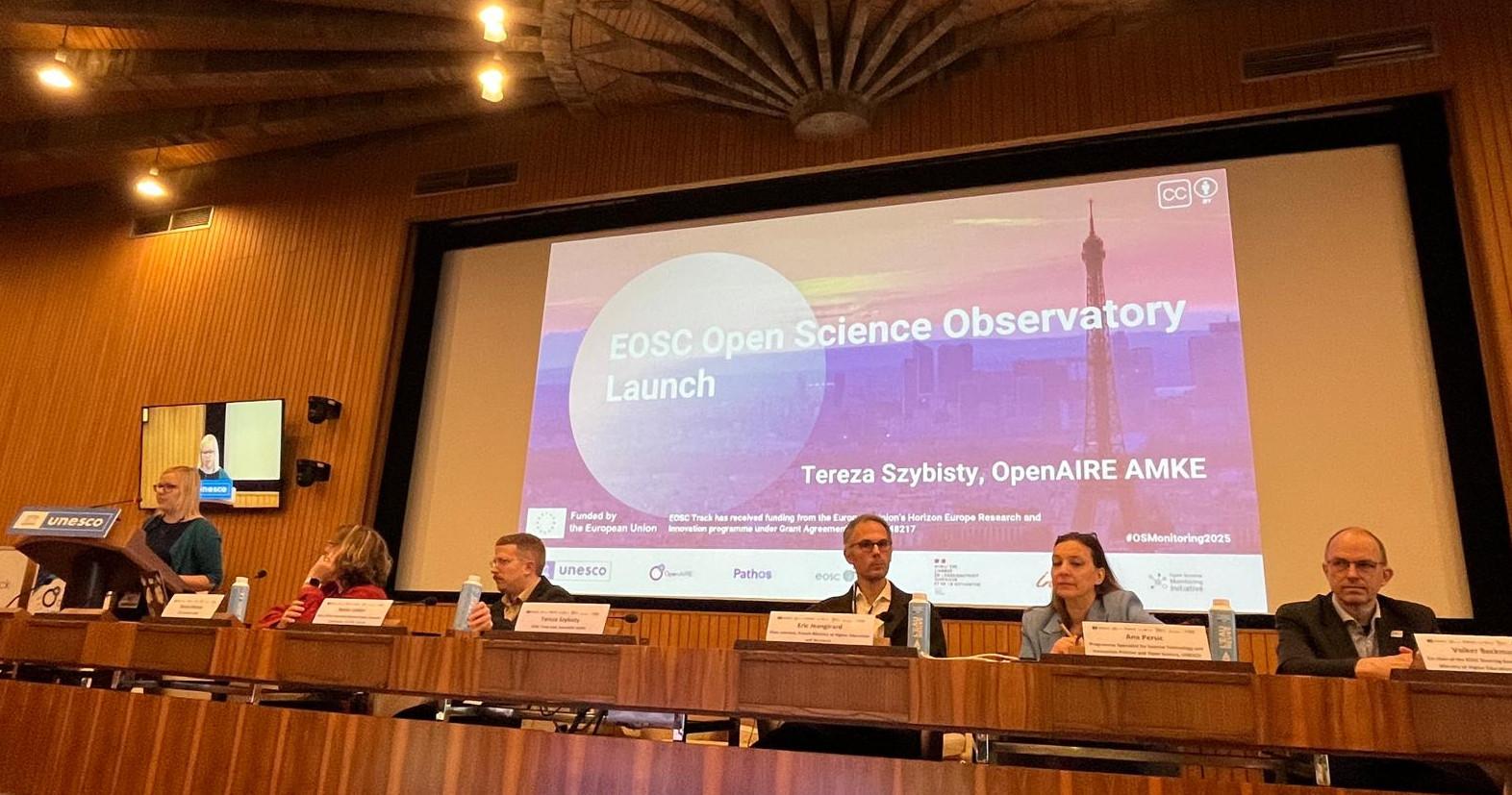
The official launch of the next phase of the EOSC Open Science Observatory was presented by Tereza Szybisty (OpenAIRE AMKE), who highlighted that the platform was built with and for the community. Co-created with national experts and aligned with initiatives like the OSMI Principles of Open Science Monitoring, the EOSC Open Science Observatory was designed to be transparent and open by design: from code and methodology to data and visualisations, everything is openly available under open licences.
Tereza walked participants through the data workflow and methodology that powers the platform. This includes a multi-level validation process for the national survey responses, enrichment and aggregation pipelines from the OpenAIRE Graph, and the integration of qualitative insights from country narratives and emerging sources like the European Open Science Resources Registry. She concluded with lessons learned: monitoring is a learning process, and frameworks must remain adaptable and reflective, evolving alongside Open Science.
From National to Global - How can national, European, and global monitoring systems interoperate while staying locally relevant?
The session concluded with a panel discussion moderated by Natalia Manola (OpenAIRE AMKE), bringing together national, EU, and global perspectives on Open Science monitoring. Panelists included:
-
Eric Jeangirard, Data Scientist at the French Ministry of Higher Education and Research, offered insights into national monitoring frameworks and the French experience with aligning national dashboards with broader European initiatives.
-
Volker Beckmann, Co-chair of the EOSC Steering Board, highlighted the EOSC Steering Board’s efforts to build a coordinated monitoring system that respects national diversity while contributing to a shared European evidence base.
-
Ana Persic, Programme Specialist at UNESCO, connected the conversation to the global level, sharing how UNESCO’s work on monitoring the implementation of the Open Science Recommendation is creating a common, global reference point that still allows for regional and national adaptations.
-
Stefan Liebler, European Commission (DG RTD), reinforced the need for a federated approach, where monitoring is built from the ground up, but structured enough to allow comparability and strategic alignment.
The panel underscored the importance of shared definitions, the need for balanced and inclusive monitoring frameworks, and the value of embedding monitoring into broader policy and institutional strategies. It also served as a reminder that behind every dataset are real practices, policies, and people working to make Open Science a reality.
What comes next?
The launch of the EOSC Open Science Observatory is just the beginning. New features, expanded data sources, and deeper community engagement are on the horizon. Monitoring is not a static task—it’s a dynamic, collaborative process that supports the evolution of Open Science.
Stay tuned for more!
Read more …Launch at UNESCO: The Second Phase of EOSC Open Science Observatory
- Hits: 536